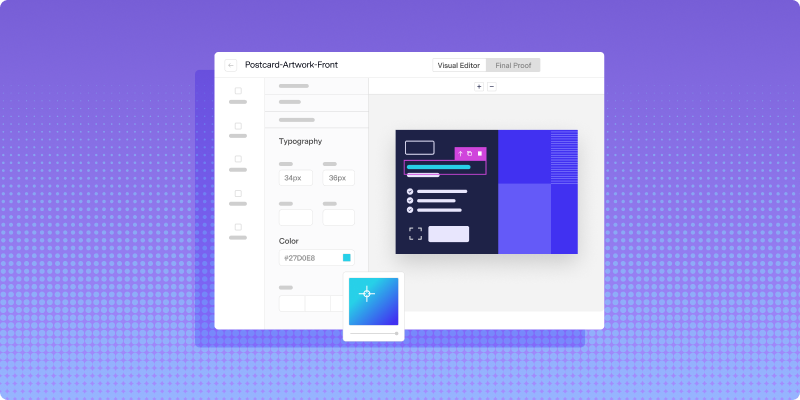

Sending direct mail is easy. Building a program that is automated, personalized, measurable, secure, and able to scale is much harder.
Many providers handle only one part of the process. When campaign management, customer data, printing, delivery, and reporting are disconnected, your team is still left moving files, coordinating vendors, and piecing together performance data.
Lob brings those pieces together in one direct mail marketing platform. Teams can create and personalize campaigns, verify addresses, automate sends, manage production, and track individual mailpieces through one connected workflow.
What sets Lob apart in direct mail marketing
Lob treats physical mail like a digital channel.
Instead of relying on manual file transfers and separate print vendors, teams can manage the process through one platform. Marketing teams can launch campaigns through the dashboard or existing marketing tools. Engineering teams can use APIs to trigger mail from customer activity. Operations teams can monitor production and delivery without chasing vendors for updates.
Lob connects campaign creation, customer data, address verification, production, delivery tracking, and reporting without requiring teams to build a separate workflow for each send.
Why automated direct mail beats legacy workflows
Traditional direct mail depends on handoffs. A team exports a list, sends files to a printer, waits for proofs, approves production, and then waits for an estimated delivery date. Every revision adds time, and visibility often disappears once the mail enters production.
Direct mail automation replaces those disconnected steps with rules and triggers. A postcard can be sent when a customer abandons a cart. A renewal notice can be generated when an account reaches a certain date. A win-back campaign can begin when a customer has been inactive for a set period.
Customer data determines who receives the mail, what appears on it, and when it is sent. This turns direct mail into part of an ongoing customer journey instead of a one-time print project.
The Lob features that drive direct mail performance
A strong direct mail platform needs to manage both the digital workflow and the physical delivery process. Lob is built around that full journey.
End-to-end campaign automation
Campaigns can be launched through the Lob dashboard, connected marketing tools, or APIs. Once the workflow is set up, mail can be triggered automatically using customer, account, or behavioral data.
That reduces repetitive manual work and gives teams a consistent process for marketing campaigns, lifecycle communications, and operational mail.
A nationwide Print Delivery Network
Direct mail performance depends on print capacity, materials, production quality, and where each job is produced.
Lob’s nationwide Print Delivery Network coordinates production across a distributed group of vetted print partners. Jobs can be routed based on factors such as format, volume, capacity, available materials, destination, and regulatory requirements.
A distributed network reduces dependence on a single facility and provides more flexibility when volume changes or disruptions occur. Lob’s production and tracking infrastructure also gives teams visibility into the process without requiring them to manage multiple print vendors directly.
Mailpiece-level production and delivery visibility
A campaign is not successful simply because it was printed.
Lob provides visibility into production and delivery events so teams can see whether mailpieces are progressing as expected rather than relying only on a batch-level “sent” status. This helps marketers understand where mail is, when it is expected to arrive, and whether delays need attention.
That information is especially important for seasonal promotions, events, renewals, and time-sensitive notices. It also helps teams coordinate email, SMS, paid media, or sales outreach around expected delivery.
Measurable campaign performance
Teams can use QR codes, personalized URLs, offer codes, dedicated phone numbers, and CRM activity to connect physical mail with customer response. Production and delivery data add context by showing whether the mail reached its intended campaign window.
Connecting those signals helps teams compare campaign costs with revenue, conversions, or other outcomes. Lob’s guide to direct mail ROI covers the metrics and attribution methods teams can use to evaluate and improve performance.
Address verification and data quality
Bad addresses waste creative, printing, and postage budget before a campaign has a chance to perform.
Lob’s address verification tools help validate, standardize, and enrich address data before mail enters production. Teams can verify addresses individually, in bulk, or as customers enter them into a website or application.
Improving address quality reduces preventable delivery failures and keeps teams from cleaning a list in one system before transferring it into another.
Personalized direct mail at scale
Personalization should go beyond adding a first name.
Lob can use customer data to change the message, image, offer, location, or call to action on each mailpiece. A retailer can feature products based on purchase history. A subscription company can personalize a renewal reminder. A financial services company can change content based on account status.
Reusable templates and variable data allow teams to generate individualized mail without creating a separate file for every recipient. That makes personalized direct mail campaigns at scale practical for onboarding, abandoned-cart recovery, renewals, post-purchase follow-up, and re-engagement.
APIs and marketing integrations
Marketing teams may want an accessible campaign workflow, while engineering teams need direct control and operations teams need auditability.
Lob supports those needs through direct mail APIs and integrations that connect with CRM, customer data, marketing automation, and analytics tools. Teams can choose the workflow that fits their technical resources rather than relying on a fully manual process or a custom build.
The same customer behavior that triggers an email or SMS can also initiate a mailpiece, helping direct mail operate as part of the broader marketing stack.
Security and compliance
Direct mail often contains sensitive information, especially in healthcare, financial services, insurance, and other regulated industries.
Lob’s security and compliance practices include encryption, access management, independent assessments, and support for frameworks such as SOC 2 and HIPAA. Its print network is also regularly audited against security, privacy, and operational standards.
These controls help organizations automate sensitive physical communications while reducing the risks created by manual file transfers and loosely controlled vendor workflows.
More sustainable direct mail operations
Better targeting, cleaner address data, and efficient production can reduce unnecessary mail and wasted materials.
Lob’s sustainable direct mail program includes responsibly sourced materials, recycled content for letter and postcard mailings, carbon offsets, and reforestation initiatives. Lob also states that mail sent through its platform is carbon neutral across its lifecycle.
This gives organizations a more consistent way to apply sustainability requirements across their programs.
How Lob fits into your marketing tech stack
Direct mail works best when it is connected to the rest of the customer experience.
Email can support frequent communication, SMS can deliver immediate reminders, and direct mail can provide a physical touchpoint when a message needs more attention.
Lob lets teams use the same customer and behavioral data across channels. A customer who ignores an email can receive a postcard. A lapsed customer can receive a win-back piece followed by digital outreach. A renewal notice can be initiated before an account expires.
Teams can trigger direct mail from CRM events such as a new account, abandoned cart, inactivity threshold, or approaching renewal window. The goal is not to replace digital marketing. It is to use direct mail where it has a clear role in the sequence.
Why Lob is stronger than a fragmented direct mail workflow
The most important comparison is not between feature lists. It is between a connected platform and a collection of disconnected tools.
A traditional print vendor may produce the mail while leaving your team responsible for data preparation, vendor coordination, delivery monitoring, and reporting. An API-only provider may automate submission without managing the broader campaign or production workflow.
Lob brings the digital and physical parts of direct mail together. Teams can control campaign strategy and customer data while Lob manages the infrastructure required to verify, produce, and track the mail.
That is the difference between digitizing one step of direct mail and modernizing the entire process.
How to choose the right direct mail marketing platform
Start with the type of mail you plan to send. Occasional marketing campaigns have different requirements from ongoing transactional, lifecycle, or regulated communications. Consider how campaigns will be triggered, how much personalization you need, and which teams will manage them.
Then look beyond campaign creation. Ask how the provider handles address quality, print capacity, production disruptions, security, delivery tracking, integrations, and reporting.
The platform should also work across departments. Marketing may need an accessible campaign builder, engineering may need APIs, and operations may need reliable records and production visibility.
Finally, evaluate the physical infrastructure. The provider should explain where mail is produced, how quality is maintained, what happens during a disruption, and what delivery data your team receives.
Build a more connected direct mail program with Lob
Direct mail should not require a collection of spreadsheets, email threads, print vendors, and disconnected reporting tools.
Lob gives teams one platform for creating, automating, producing, and tracking physical mail. Campaigns can respond to customer behavior, use personalized data, connect with existing marketing systems, and remain visible throughout production and delivery.
Book a demo to see how Lob can help your team build a faster, more measurable direct mail program.
Frequently asked questions about Lob and direct mail marketing
FAQs

What is a direct mail marketing platform?
A direct mail marketing platform is software that helps businesses create, personalize, automate, send, and track physical mail. Modern platforms connect campaign tools and customer data with printing, postal preparation, and delivery infrastructure.
What makes Lob different from a traditional print vendor?
A traditional print vendor primarily produces physical materials. Lob connects campaign creation, customer data, automation, address verification, distributed print production, and delivery tracking in one platform.
Can Lob integrate with a CRM or marketing automation platform?
Yes. Lob offers APIs and integrations that allow direct mail to connect with CRMs, customer data platforms, marketing automation systems, analytics tools, and internal applications.
Does Lob support personalized direct mail?
Yes. Lob supports reusable templates, variable data, and customer-data integrations so teams can personalize text, imagery, offers, and other campaign elements at scale.
How does Lob track direct mail?
Lob provides visibility into production and delivery events at the mailpiece level. Teams can monitor campaign status, evaluate deliverability, identify delays, and connect mail activity with downstream customer actions.
Answered by:

Sam Melero
.png)