
Most direct mail software promises fast delivery and easy tracking. But those promises do not mean much when a time-sensitive campaign misses its window because mail entered the postal system far from its final destination or spent longer than expected moving between processing facilities.
The difference between mail that arrives on time and mail that arrives too late often comes down to how a platform handles USPS logistics. Where is each piece printed? Where does it enter the postal network? Is the address deliverable? Can your team see meaningful tracking events after the campaign is sent?
The right software should manage these operational decisions automatically. This guide covers the features that have the greatest effect on timing, deliverability, and postage costs, including CASS-certified address verification, presort automation, USPS tracking, and distributed print production.
How USPS logistics shapes direct mail delivery timing
Delivery timing is not determined only by when you submit a campaign. It depends on how the mail is prepared, where it enters the USPS network, how far it must travel, and how much processing USPS must complete before it reaches the recipient’s local post office.
When evaluating direct mail software for USPS logistics, focus on three foundational capabilities:
- Intelligent Mail Barcode integration
- Tracking data from USPS Informed Visibility
- CASS-certified address verification
Together, these features help mail move more efficiently, avoid preventable address problems, and qualify for applicable postal rates.
The platform should also make routing decisions that affect direct mail delivery speed without requiring your team to coordinate manually with printers, logistics providers, and USPS facilities.
Presort, drop shipping, and last-mile delivery
Three terms come up frequently when comparing direct mail platforms:
Presort: Organizing mail according to ZIP Code and other USPS requirements before it is submitted. Presorted mail may qualify for postage discounts because some of the sorting work has already been completed.
Drop shipping: Transporting prepared mail closer to its destination before entering it into the USPS network. Entering mail at a destination facility can reduce the distance it travels within the postal system.
Last-mile delivery: The final stage in which mail moves from the local post office to the recipient’s mailbox. Direct mail software cannot control carrier delivery, but it can influence how efficiently mail reaches the correct destination facility.
Look for software that incorporates presort, routing, and USPS entry-point decisions into the production workflow. If your team must coordinate each step manually, maintaining predictable delivery windows becomes much harder.
Why mail class affects the in-home date
Mail class is one of the most important factors affecting both delivery timing and postage costs.
A lower-cost class may work well for evergreen promotions, but it may not be appropriate for appointment reminders, enrollment notices, event invitations, or offers with a firm expiration date.
Direct mail software should make the tradeoff between postage optimization and delivery speed clear before a campaign is submitted. Saving money on postage does not help if the campaign arrives after its opportunity to influence the recipient.
First-Class Mail for time-sensitive sends
First-Class Mail is commonly used for transactional communications, personalized correspondence, and campaigns with narrower delivery windows.
It may be appropriate for:
- Appointment and renewal reminders
- Account and service communications
- Time-sensitive offers
- Personalized customer correspondence
- Notices connected to regulatory or contractual deadlines
Because First-Class Mail generally costs more than Marketing Mail, the platform should help teams decide when faster handling justifies the additional expense.
USPS Marketing Mail for high-volume campaigns
USPS Marketing Mail is intended for eligible bulk promotional mailings. It can offer a lower cost per piece, but delivery windows are generally broader than those associated with First-Class Mail.
It often works well for:
- Customer acquisition campaigns
- Promotional postcards
- Catalogs
- Brand-awareness mailings
- Offers without strict response deadlines
Look for software that shows expected delivery ranges before submission rather than presenting First-Class Mail and Marketing Mail as interchangeable options.
Every Door Direct Mail for geographic saturation
Every Door Direct Mail, or EDDM, allows businesses to send eligible mailpieces to addresses across selected carrier routes without using a traditional recipient list.
It can be useful for:
- Store openings
- Local service promotions
- Community events
- Neighborhood-specific offers
- Geographic market expansion
Organizations that rely on local saturation campaigns should confirm whether a platform supports EDDM workflows and carrier-route targeting.
Address verification and list hygiene requirements
A campaign can be printed on schedule and still arrive late—or never arrive at all—when the underlying address data is inaccurate.
Reliable address verification should be built into the mailing workflow and happen before production begins. Your team should not have to upload its list to a separate service, wait for the results, and then import a corrected file back into the platform.
CASS-certified address verification
The Coding Accuracy Support System, or CASS, is a USPS certification program for address-matching software.
CASS-certified verification can help:
- Standardize address formatting
- Add available ZIP+4 information
- Correct certain address components
- Identify addresses that do not match USPS records
- Prepare addresses for automated USPS processing
Direct mail software should run these checks automatically. If address verification depends on someone remembering to perform a separate manual step, errors are more likely to make it into production.
NCOA processing for address changes
The National Change of Address database contains address-change information submitted to USPS by people and businesses that have moved.
NCOA processing can help identify outdated recipient information before mail is produced. Otherwise, a mailpiece may be forwarded, delayed, returned, or discarded depending on the mail class and recipient circumstances.
Ask potential vendors:
- Whether NCOA processing is available
- Whether it happens automatically or on request
- How recently the address data was updated
- How changes and exceptions are reported
- Whether corrected addresses can flow back into your system of record
Automated list hygiene and deduplication
Address verification is only one part of maintaining a healthy mailing list. The platform should also catch other data issues before they create wasted printing and postage.
Useful list-hygiene capabilities include:
Standardization: Correcting inconsistent formatting and placing address information in the appropriate fields.
Deduplication: Preventing multiple pieces from being sent unnecessarily to the same recipient or household.
Deliverability flagging: Identifying incomplete, invalid, or otherwise questionable addresses before production.
Suppression rules: Excluding recipients who have opted out or should not receive a particular campaign.
The most important address quality checks for direct mail operations should happen within the workflow, not through spreadsheet exports and manual file cleanup.
Distributed print networks for faster delivery
Where a mailpiece is printed affects how far it must travel before reaching its intended market.
A campaign targeting recipients in California may take longer when every piece is produced at a single facility on the East Coast. Printing closer to recipients can reduce unnecessary transportation before or during USPS processing.
A distributed production model routes campaigns across multiple print facilities according to recipient geography, capacity, format, and timing requirements. Understanding how nationwide distributed print networks work can help teams evaluate whether a vendor is equipped to support campaigns across multiple regions.
When comparing print networks, ask about:
- Geographic coverage
- Automated facility selection
- Available production capacity
- Quality-control standards
- Redundancy when one facility is unavailable
- Contingency plans for severe weather or equipment problems
- Consistency across printers and locations
A vendor with only one facility may create longer transit distances and a single point of failure. A distributed network can offer greater flexibility, but only when the vendor applies consistent production and quality standards across the network.
Real-time delivery tracking and visibility requirements
Some vendors describe a campaign as tracked once it has been printed or handed to USPS. That does not provide enough information to understand how mail is progressing through the postal system.
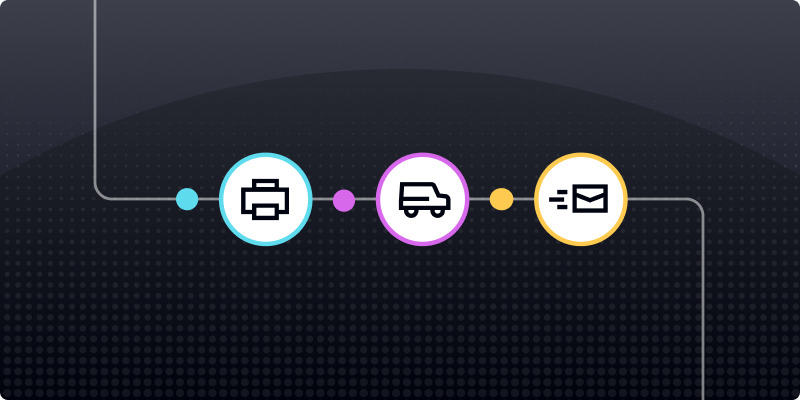
Useful production and delivery tracking should provide visibility from campaign submission through printing, USPS induction, and postal processing.
Intelligent Mail Barcode and Informed Visibility
The Intelligent Mail Barcode, or IMb, is printed on eligible mailpieces and scanned as mail moves through USPS processing equipment.
USPS Informed Visibility provides scan-event data associated with those barcodes. Direct mail software can ingest the data and translate it into campaign and mailpiece tracking updates.
However, IMb tracking should not be treated exactly like package tracking. A processing scan does not necessarily confirm that a carrier placed an individual piece in a specific mailbox.
A strong platform should clearly distinguish between:
- Production events
- USPS induction events
- Processing scans
- Estimated delivery events
- Returned or undeliverable mail
- Confirmed responses and conversions
Understanding which mail tracking signals matter helps teams avoid interpreting estimated or intermediate events as guaranteed household delivery.
Tracking data in the campaign dashboard
Your team should not have to log in to a separate USPS portal or contact a print vendor every time it needs an update.
The direct mail platform should surface events such as:
- Campaign submitted
- Campaign approved for production
- Printing completed
- Mail entered into the USPS network
- USPS processing events received
- Mail nearing its destination
- Estimated delivery completed
- Mailpiece returned or rerouted
Tracking terminology should be defined clearly. Ask vendors which events come directly from USPS, which are generated by the platform, and which are estimated based on historical or operational data.
Webhooks and event triggers
Tracking becomes more valuable when events can trigger actions elsewhere in your marketing stack.
For example, a business might:
- Send an email when a mailpiece is expected to arrive
- Create a follow-up task for a sales representative
- Alert a call center that mail has reached a particular region
- Begin a post-delivery attribution window
- Suppress follow-up messages after a recipient converts
- Update a customer’s campaign status in the CRM
Webhooks and APIs turn direct mail into part of a coordinated customer journey rather than a disconnected offline channel.
Postage optimization and cost-control features
Postage is often one of the largest direct mail expenses, but the lowest available rate is not automatically the best choice.
The platform should balance postage cost with campaign urgency, mailpiece format, mailing volume, recipient geography, and delivery expectations.
Automated presort and USPS entry-point optimization
Direct mail software should evaluate recipient distribution and campaign volume to determine how mail can be prepared and entered into the postal network efficiently.
Look for capabilities that support:
- Automated presort preparation
- Postal documentation
- Entry-point selection
- Destination-based routing
- Applicable automation discounts
- Postage estimates before submission
The vendor should be able to explain how its routing and postage decisions are made. Treat a completely opaque process as a warning sign, especially when delivery timing is important.
Format and weight optimization
Mailpiece dimensions, thickness, shape, and weight can affect postage eligibility and cost.
Software should identify design choices that could move a piece into a more expensive postal category. A minor change in size or weight could affect whether a piece qualifies as a postcard, letter, or flat.
At scale, finding these problems before production can prevent significant unnecessary costs.
Transparent campaign pricing
Ask whether the displayed campaign price includes:
- Printing
- Paper and finishing
- Postage
- Address verification
- Presort preparation
- Tracking
- Platform or processing fees
- Specialty format charges
A low advertised cost per piece may not reflect the final campaign expense once postage and additional services are included.
Integrations that connect USPS data to your marketing stack
Direct mail data becomes more useful when it flows into the systems your teams already use.
A standalone tracking dashboard may provide some visibility, but it still creates manual work if campaign activity must be copied into a CRM, marketing platform, or reporting tool.
CRM and marketing automation triggers
Look for APIs and integrations that support bidirectional workflows.
Teams should be able to trigger direct mail based on events such as:
- Cart abandonment
- Lead-status changes
- Subscription milestones
- Customer inactivity
- Upcoming renewals
- Appointment deadlines
- Enrollment activity
- Digital engagement
Campaign, production, and delivery data should also flow back into systems such as Salesforce, HubSpot, Marketo, or a company’s internal customer platform.
Reporting and attribution connections
Direct mail performance should be measured alongside email, paid media, and other marketing channels.
Useful reporting capabilities may include:
- Campaign and production statuses
- Delivery estimates
- Response and conversion tracking
- QR code activity
- Personalized URL visits
- Offer-code redemptions
- CRM attribution
- Exportable event data
Unified reporting helps teams understand direct mail’s role in a conversion rather than evaluating it as an isolated channel.
Vendor SLAs, security, and USPS expertise
Software features matter, but operational reliability also depends on the organization behind the platform.
Print and mail service-level agreements
Ask for specific commitments covering the time between campaign submission, production, and USPS induction.
A useful service-level agreement should explain:
- When production time begins
- Standard and expedited turnaround times
- Submission cutoff times
- Factors that can delay production
- How exceptions are communicated
- What happens when a facility cannot fulfill an order
Vague promises such as “fast turnaround” are less useful than documented operating standards.
Security and compliance
Direct mail campaigns may contain personal, financial, healthcare, or other sensitive information.
Depending on your use case, evaluate:
- SOC 2 documentation
- HIPAA-related controls and agreements
- Data encryption
- Platform access controls
- Data-retention policies
- Production-partner security
- Incident-response procedures
Verify security and compliance claims through current documentation rather than relying only on logos displayed on a vendor’s website.
USPS and postal-operations experience
A direct mail platform should do more than send a completed file to a printer.
Ask how the vendor:
- Keeps postal rates and requirements current
- Handles USPS documentation
- Makes entry-point and presort decisions
- Collects and interprets USPS scan data
- Responds to postal disruptions
- Supports high-volume and geographically distributed sends
- Communicates delays or production exceptions
The goal is to find a partner that understands how to move mail through USPS infrastructure, not simply one that can print it.
Red flags when evaluating direct mail software
Tracking stops at “mailed”
A mailed status confirms that a piece entered the fulfillment process. It does not tell you how it is moving through USPS or when it is likely to arrive.
No visibility into routing decisions
If the vendor cannot explain where mail is printed, how it is routed, or where it enters USPS, it will be difficult to diagnose delays or evaluate postage efficiency.
Manual address cleanup and file handoffs
Workflows built around spreadsheet exports, emailed CSV files, and manual corrections add time and create unnecessary opportunities for errors.
A single print facility with no redundancy
One production location can create longer transportation distances and a single point of failure. Ask what happens when capacity is limited or a facility becomes unavailable.
Delivery estimates presented as guarantees
USPS scan data and historical performance can support delivery estimates, but most standard direct mail services do not guarantee a household delivery date. Be cautious when a vendor presents estimates as certainties.
Unclear pricing
If the vendor cannot separate printing, postage, processing, and platform costs, comparing it with other options becomes difficult.
Make USPS logistics work for you with Lob
Lob brings address verification, intelligent routing, distributed production, USPS tracking data, and marketing integrations into one direct mail platform.
Teams can use Lob to trigger mail programmatically, route campaigns through a nationwide Print Delivery Network, monitor production and postal events, and connect direct mail activity with the rest of their technology stack.
Instead of coordinating address preparation, printing, postal entry, and tracking across multiple vendors, businesses can manage direct mail through one platform built to support campaigns at scale.
Ready to improve the timing, visibility, and efficiency of your direct mail operations? Book a demo with Lob.
Frequently asked questions about direct mail software and USPS delivery
FAQs

How accurate are in-home date predictions from direct mail software?
In-home date predictions are estimates, not guaranteed delivery dates. Their accuracy depends on factors such as mail class, the distance between the USPS entry point and recipient, current postal conditions, and the quality of the platform’s historical and scan data. First-Class Mail generally has narrower delivery windows than USPS Marketing Mail, but delays can still occur.
What is the difference between Intelligent Mail Barcode and Informed Visibility?
The Intelligent Mail Barcode is the physical barcode printed on an eligible mailpiece and scanned by USPS processing equipment. Informed Visibility is the USPS program that collects and shares the scan data associated with those barcodes.
Can direct mail software handle both batch campaigns and triggered sends through USPS?
Many modern platforms support both scheduled batch campaigns and individual sends triggered by events such as signups, purchases, renewals, or abandoned carts. Look for APIs, webhooks, and integrations that connect these workflows to your CRM or marketing automation platform.
How do I compare delivery SLAs across direct mail software vendors?
Ask each vendor for written service-level agreements covering the time from campaign submission to production and USPS induction. Also review submission cutoff times, exceptions, available remedies, and historical performance data. Be cautious of vendors that present estimated USPS delivery dates as guaranteed SLAs.
Answered by: