
Nationwide direct mail campaigns have become more efficient as distributed print networks bring production closer to recipients. Instead of printing everything in a single facility and shipping it across the country, distributed printing uses multiple strategically located printers to support more predictable delivery and more manageable logistics.
This guide breaks down how distributed printing works, what separates enterprise-grade networks from basic fulfillment, and how to evaluate providers for your next large-scale campaign.
What is a nationwide print delivery network
A nationwide print delivery network uses multiple print facilities positioned across key regions rather than a single centralized plant. Software behind the network automatically routes each mailpiece to a facility that is well suited for that recipient’s location and the campaign’s goals.
If your workflow includes list preparation or mailpiece generation, tools such as address verification can help ensure each record is ready for automated routing and production.
What qualifies as true nationwide coverage
True nationwide coverage means having production capabilities across major U.S. regions, such as the East Coast, West Coast, Midwest, and South, with access to key metropolitan areas. Some providers describe their services as “nationwide” while still printing from a single facility and shipping everywhere, which does not offer the same benefits.
A genuinely distributed network positions printers near major USPS distribution hubs and population centers. When mail enters the postal stream closer to its final destination, it can avoid long cross-country legs and reduce the number of handoffs in transit.
How intelligent routing to the nearest printer works
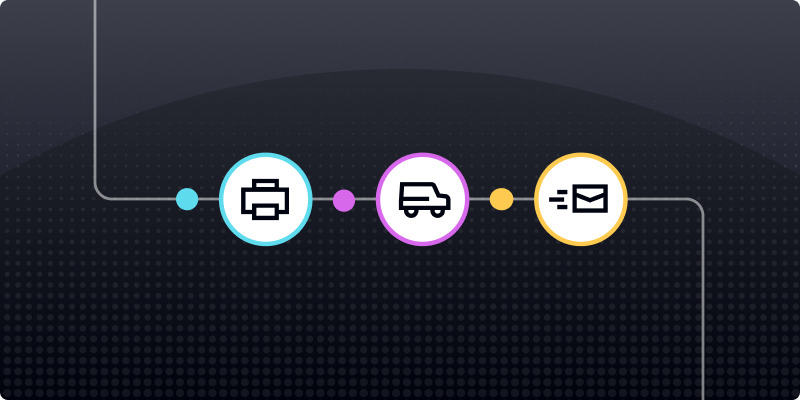
Routing mail to the best production location happens through software that evaluates each recipient’s address and the state of the network. A typical flow looks like this:
- Address analysis: The system reads the recipient’s ZIP Code
- Facility matching: It selects a qualified printer that serves that region and has appropriate capacity
- Automatic optimization: It considers production timelines, USPS entry points, and delivery requirements
Once you launch a campaign, the platform processes your data, groups recipients by geography, and assigns production to the right facilities. You do not have to coordinate individual jobs with multiple printers. The routing logic handles it behind the scenes.
How distributed printing influences postage and transit times
When mail is printed closer to its destination, it can enter the USPS system later in the journey. This is often called zone skipping. By entering the network at a facility closer to the recipient, mail may travel through fewer postal zones and require less long-distance transportation.
Distributed printing can also support more predictable in-home dates across regions, because pieces do not all depend on a single origin point and a single long shipping leg before they reach USPS. This can make it easier to coordinate campaigns across multiple markets.
Why distributed printing can outperform single-facility vendors
The differences between distributed and centralized printing become more significant as campaign volume grows. Single-facility vendors print everything in one place and ship it everywhere, which can introduce bottlenecks and longer transit paths.
More predictable in-home delivery windows
When mail is printed at facilities closer to recipients, it generally spends less time in long-distance transit before entering the local postal network. This can support more consistent delivery timelines and reduce variability across regions.
This matters when you are coordinating direct mail with other channels or planning campaigns around specific timeframes. A distributed network gives you more flexibility to plan around realistic in-home windows.
Consistent brand and color quality across locations
A common concern with distributed printing is whether quality will remain consistent across facilities. The answer depends on the network’s standards and controls.
Many enterprise-grade networks rely on established color standards such as G7 and processes that align to specifications like Gracol. Facilities following these standards use consistent color profiling, inks, and calibration practices so brand colors and images appear consistent regardless of where a piece is printed.
Ongoing quality checks, regular calibration, and sample audits add another layer of oversight, helping catch issues before they reach full production.
Lower freight complexity and environmental impact
Producing mail closer to recipients can reduce the amount of long-distance freight involved in a campaign. This may simplify logistics planning and can support sustainability goals by reducing transportation-related emissions and packaging used for long transit.
For organizations with ESG or sustainability initiatives, distributed printing offers a way to support those objectives while still maintaining scale.
What to look for in a direct mail fulfillment provider
Evaluating providers is easier when you focus on the capabilities that distinguish basic fulfillment from enterprise-ready networks.
Color and quality consistency
Look for providers that can describe their color management standards, calibration processes, and inspection routines. Consistency across facilities is especially important for brand-heavy assets like postcards, self-mailers, and letters that feature logos and photography.
Ask how often presses are calibrated, whether test sheets are reviewed, and what happens when a facility falls out of tolerance.
Delivery tracking and visibility
Modern direct mail programs benefit from knowing where pieces are in the production and delivery process. Piece-level tracking and USPS scan events make it possible to:
- Time follow-up emails and other channels
- Understand regional delivery patterns
- Report on campaign performance with real data
Platforms that offer mail tracking or similar visibility help ensure every piece is accounted for throughout the workflow.
API integrations for automated direct mail
API connectivity allows direct mail to behave more like a digital channel. When someone abandons a cart, reaches a milestone, or becomes inactive, your systems can trigger a personalized mailpiece automatically.
This removes the need for repeated file exports, uploads, and manual proof cycles. Instead, direct mail becomes an integrated part of your broader customer journey.
Data security and compliance posture
If your campaigns involve sensitive or regulated data, you will need to understand how a provider handles security and compliance. Ask for documentation on their controls, audit reports where applicable, and how they manage data throughout production and delivery.
Look for clear explanations of how data is stored, who can access it, and how it is removed when no longer needed.
How to transition to an automated nationwide direct mail program
Transitioning from legacy workflows or single-facility vendors to a distributed, automated network is easier when you approach it in stages.
1. Audit your current workflows and costs
Begin by documenting your existing process:
- Which vendors and tools you use
- How much time internal teams spend on manual tasks
- Typical turnaround times
- All-in cost per piece, including freight and handling
2. Map your data sources and campaign triggers
Identify where customer data lives and how you want it to drive mail sends. Consider:
- Which systems store addresses and preferences
- Which events in your lifecycle could trigger a send
- How often segments or lists change
3. Pilot with a targeted audience segment
Instead of moving your full program at once, run a controlled pilot to evaluate:
- Delivery timing
- Consistency across regions
- Ease of execution and setup
4. Scale and optimize
When the pilot performs as expected, expand to additional campaigns and refine your workflows through testing.
Power your direct mail at scale
A nationwide print delivery network can transform direct mail from a manual, batch-based channel into an automated, data-driven part of your marketing mix. Distributed printing, intelligent routing, standardized quality controls, and delivery tracking all work together to support scalable programs.
If you want to see how this model could work for your organization, you can explore a platform with a nationwide print delivery network and automated workflows.
Book a demo to learn how Lob supports direct mail programs at scale.
FAQs

What mail volume makes a nationwide print delivery network worthwhile
Distributed networks work for a wide range of send volumes, but organizations mailing across multiple regions tend to benefit most from the consistency and automation. If your workflow includes list prep or validation, tools like address verification can support cleaner data going into production.
How long does it take to launch a direct mail campaign with a distributed print network?
Timelines vary based on setup and workflow. Once templates and data connections are established, many campaigns can move from approval to production faster than traditional, highly manual processes.
Can you use your own designs and mailing lists with a print delivery network provider?
Most providers accept custom creative and recipient lists in standard formats such as CSV files and print-ready PDFs. Some also offer templates or drag-and-drop builders if you prefer to design within the platform.
How do print delivery networks handle personalization at scale?
Variable data printing and data integrations allow each piece to be customized for individual recipients—even in high-volume or recurring mail programs. Integrating these workflows through an API or automation layer keeps personalization consistent.
What compliance considerations matter when choosing a fulfillment provider?
When evaluating providers, look for documented data protection practices and clarity around access control, retention, and secure data handling. Networks that include transparent reporting and mail tracking often make compliance reviews easier.
Answered by: