A postcard has one advantage over almost every digital ad: the recipient has to physically handle it. That moment is brief, though. If the offer is buried, the design feels generic, or the next step is unclear, the postcard is easy to dismiss.
The strongest postcard marketing campaigns make the message obvious, relevant, and easy to act on. These five tips can help you create postcards that capture attention and drive measurable responses.
1. Keep the postcard simple
A postcard has limited space, but that does not mean you need to fill every inch of it.
Too many offers, long paragraphs, competing images, and multiple calls to action make it difficult for recipients to understand what matters. Instead, build the design around:
- One primary message
- One relevant offer
- One visual focal point
- One clear next step
Use the front of the postcard to capture attention and communicate the main benefit. Reserve the back for supporting details, offer terms, and the call to action.
Visual hierarchy matters, too. The headline or offer should be the first thing recipients notice. Supporting copy should provide only the information they need to decide whether to act.
Postcard dimensions also affect how much information you can include without overwhelming the design, so choosing the right direct mail format, size, and shape should be part of the creative process from the beginning.
Before approving the postcard, show it to someone unfamiliar with the campaign. Ask them what the offer is and what they are supposed to do next. If they cannot answer immediately, simplify the design.
2. Send relevant offers
Even a well-designed postcard will underperform when the offer has little connection to the recipient.
Use customer data from your CRM, ecommerce platform, or marketing automation system to determine which message each person should receive. You might personalize the postcard based on:
- Previous purchases
- Products or services viewed
- Customer location
- Membership or subscription status
- Purchase frequency and recency
- Renewal or expiration dates
- Loyalty status
- Abandoned actions
Personalization should go beyond adding a first name. The offer, imagery, timing, products, and call to action can all change based on what you know about the recipient.
For example, an active customer should not necessarily receive the same promotion as someone who has not purchased in a year. A customer approaching a renewal date may need a reminder, while a recent buyer may respond better to a complementary product or loyalty offer.
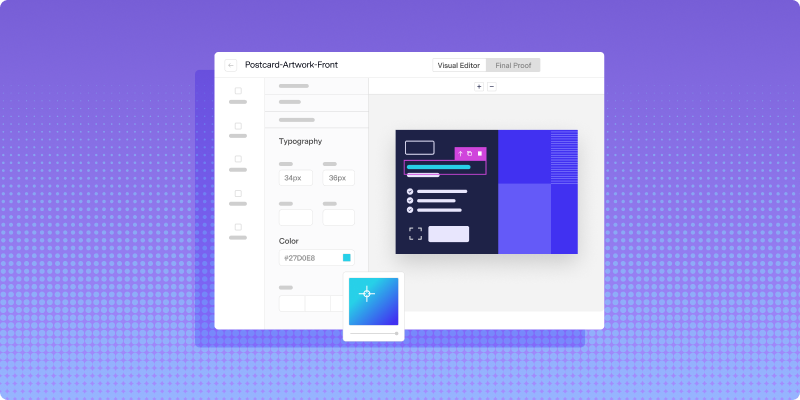
Teams can create personalized direct mail campaigns at scale by connecting customer data to reusable templates instead of designing each postcard manually.
3. Match the message to the audience
The postcard should reflect the recipient’s relationship with your business. A prospect who has never heard of your company needs a different message from a long-term customer.
Start by identifying who will receive the postcard:
- Prospective customers
- First-time buyers
- Repeat customers
- Loyalty program members
- Customers approaching renewal
- Former customers you want to reactivate
Then determine what that audience needs to know.
A prospective customer may need a concise explanation of your product or service. A current customer may be more interested in a personalized recommendation or exclusive offer. A lapsed customer may respond to a reminder of the value they previously received.
Tone and imagery should also fit the audience. A postcard can look polished without feeling formal, playful without becoming confusing, or urgent without overwhelming the recipient.
Behavioral data is often more useful than broad demographic assumptions. Purchase history, lifecycle stage, previous engagement, and recent activity can reveal more about what a recipient needs at that moment.
Using those signals to personalize direct mail beyond basic name fields can make the entire postcard feel more relevant, from the featured product to the offer and call to action.
4. Automate and test postcard campaigns
Sending one postcard campaign manually may be manageable. Running several campaigns with different audiences, offers, triggers, and creative variations is where manual processes begin to break down.
Spreadsheets and disconnected vendors can lead to outdated lists, duplicate records, missed sends, and limited visibility into what is working.
Direct mail automation connects postcard campaigns to the systems your team already uses. That makes it possible to:
- Trigger postcards based on customer behavior
- Populate templates with customer data
- Verify addresses before production
- Coordinate postcards with email and digital campaigns
- Test different headlines, offers, and designs
- Track postcards through production and delivery
- Compare performance across audiences
For example, a postcard could be triggered when someone abandons a high-value purchase, reaches a customer anniversary, stops responding to email, or approaches a renewal date.
When direct mail automation connects with your marketing technology stack, postcards can become part of a coordinated customer journey rather than an isolated campaign.
When testing, change one significant element at a time. You might compare:
- Two headlines
- A percentage discount and a dollar-value discount
- Personalized and non-personalized imagery
- Different postcard sizes
- Two calls to action
- Different sending windows
Limiting each test makes it easier to identify what influenced the result.
5. Make the call to action unmistakable
Every postcard should give the recipient one clear next step.
Avoid asking people to visit your website, call your team, follow your social accounts, and use a promotional code on the same card. Choose the action that most directly supports the campaign goal.
That action might be:
- Scanning a QR code
- Visiting a short or personalized URL
- Entering a promotional code
- Calling a dedicated phone number
- Scheduling an appointment
- Visiting a nearby location
- Renewing an account
Use direct language such as “Scan to schedule,” “Claim your offer,” or “Renew by August 30.” The call to action should be visually distinct and easy to locate.
The destination should also continue the postcard’s message. Do not send recipients to a generic homepage and expect them to search for the offer. Link to a focused, mobile-friendly landing page where they can complete the action quickly.
Trackable QR codes, personalized URLs, promotional codes, and dedicated phone numbers make it easier to track direct mail campaign performance in real time and connect individual responses to specific campaigns, audiences, or creative variations.
Build a repeatable postcard marketing process
A successful postcard is not just the result of a strong design. It comes from a process that connects audience data, relevant creative, reliable production, and consistent measurement.
Start each campaign with a specific goal. Then determine which audience, offer, and call to action are most likely to support it. After the campaign runs, compare the results with previous sends and use those findings to improve the next one.
Useful measurements may include:
- Delivery rate
- Response rate
- Conversion rate
- Cost per acquisition
- Revenue per postcard
- Incremental lift
The right metrics depend on the campaign objective. A customer retention campaign should not necessarily be evaluated the same way as an acquisition campaign.
Tracking the direct mail KPIs that matter most helps teams understand whether campaigns are reaching the right people, generating responses, and contributing to broader marketing goals.
Lob brings postcard creation, personalization, address verification, printing, delivery tracking, and measurement into one automated workflow. Book a demo to see how your team can create and scale more effective postcard marketing campaigns.
Frequently asked questions about postcard marketing
FAQs

What is postcard marketing?
Postcard marketing is a form of direct mail that uses printed postcards to promote an offer, communicate with customers, drive traffic, or encourage a specific action. Postcards can support customer acquisition, retention, reactivation, renewal, and event promotion campaigns.
What makes a marketing postcard effective?
An effective marketing postcard presents a relevant message to a defined audience and makes the next step easy to understand. Strong postcards typically include a clear headline, focused offer, simple design, meaningful personalization, and one prominent call to action.
How much does postcard marketing cost?
Postcard marketing costs depend on the size, volume, paper, printing requirements, postage class, personalization, and production workflow.
Instead of evaluating a campaign only by cost per postcard, compare the total campaign cost with the number and value of the conversions it generates. A more targeted postcard may cost more per piece but produce a lower cost per acquisition.
Do marketing postcards need a QR code?
A QR code is not required, but it can give recipients a quick way to move from the postcard to a digital experience. It can also provide a trackable response method.
Other options include personalized URLs, short URLs, promotional codes, dedicated phone numbers, and location-specific offers. Choose the response method that is easiest for the audience and best aligned with the campaign goal.
How can businesses automate postcard marketing?
Businesses can connect a direct mail platform to their CRM, ecommerce system, marketing automation platform, or internal database. Customer actions or lifecycle events can then trigger postcards automatically.
Templates can populate with the appropriate customer information, offer, imagery, and call to action while the platform manages address verification, production, delivery, and tracking.
Answered by:

Sam Melero