
Most retargeting happens in digital channels like display ads, email, and social, where your message has to compete with everything else on the screen. Direct mail retargeting uses those same behavioral signals, but it follows up in a different place: the mailbox.
That shift matters. A physical piece is harder to scroll past, and it gives you another chance to reconnect with someone who already showed intent. Below, we’ll break down how direct mail retargeting works, where it fits in your current mix, and how to measure what it drives.
What is direct mail retargeting?
Direct mail retargeting sends personalized physical mail to people who interacted with your brand online but did not convert.
Common triggers include:
- Cart abandonment
- Product or pricing page views
- Multiple visits in a short time window
- Time spent on high-intent pages
- Lapsed customer behavior (for logged-in users)
Unlike traditional direct mail, you’re not blasting a static list on a fixed schedule. You’re using behavioral triggers to send the right message to the right person, close to the moment they showed intent.
How direct mail retargeting works
At a high level, the workflow looks like this:
- A visitor takes an action on your site
Think product views, checkout starts, repeat visits, or reading a key resource. - You match that activity to a mailable audience
Identity resolution can help connect certain website visitors to a household mailing address, so you can follow up even when someone never filled out a form or shared an email. Learn more about retargeting anonymous website visitors. - A mailpiece is triggered automatically
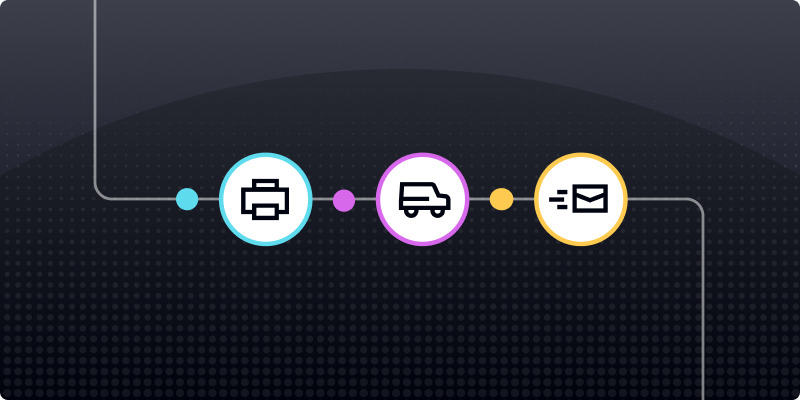
You define the rules, creative, and timing once, then the sends run continuously. - The piece is printed, mailed, and tracked
Modern platforms can give you visibility into when pieces enter the mailstream and when they’re likely to be delivered, so you can coordinate follow-ups and reporting with confidence.
If you want direct mail to behave like retargeting (not like a one-off print project), the goal is simple: connect triggers, creative, and measurement to the same system you already use for digital.
Why direct mail can outperform digital-only retargeting
It changes the environment
Digital retargeting competes with nonstop scrolling, inbox clutter, and ad fatigue. A mailpiece lands in a space that typically has less competition, which gives your message a real chance to register.
It stays visible longer
A display ad disappears the moment someone scrolls. A postcard or letter can sit on a counter or desk and create repeat impressions without additional spend.
It helps you follow up when email cannot
Email retargeting depends on an opt-in. Direct mail retargeting can help you reach certain high-intent visitors who never shared their contact details.
It’s built for measurement
Retargeting only works when you can track what happened. With modern delivery visibility, you can align your timing and reporting around when mail is actually moving, not just when it was sent.
Where direct mail fits in your retargeting mix
Direct mail works best as a supporting touchpoint, not a replacement.
A practical sequence might look like this:
- 0 to 4 hours after abandonment: email reminder (if you have opt-in)
- 24 to 72 hours after abandonment: display and paid social retargeting
- 48 to 96 hours after abandonment: trigger a postcard or letter for high-intent segments
The point is not to choose one channel. The point is to layer touchpoints so each one does what it’s best at.
Audiences that respond best to retargeted direct mail
Cart abandoners
They already showed buying intent. Use a reminder, social proof, or a small nudge that reduces friction.
Anonymous high-intent visitors
These are visitors who repeatedly browse, view key pages, or spend meaningful time, but never fill out a form. Direct mail can be one of the only ways to follow up at a household level.
Lapsed customers and single-purchase buyers
They know your brand already. A physical reminder plus a relevant next offer can help pull them back into the funnel.
Email non-responders
Some contacts simply don’t engage with email anymore. That doesn’t always mean they’re not interested. It can mean you’re reaching them in the wrong channel.
How to personalize direct mail retargeting
Personalization isn’t just a first name. The best retargeting mail feels like it follows what the person just did.
Ways to personalize without getting creepy:
- Feature the category they browsed, not necessarily the exact product
- Match messaging to journey stage (first visit vs repeat visitor vs lapsed customer)
- Tailor the CTA by intent (finish checkout, compare options, schedule a consult)
- Test format by segment (postcard for simple offers, letter for complex decisions)
The goal is relevance. If the piece feels generic, it won’t perform like retargeting.
How to track and measure direct mail retargeting performance
Track delivery, not just sends
You want to know when mail is moving and when it’s likely in-home so you can time your follow-ups. That’s why delivery tracking matters. Here’s how mail tracking typically works in a modern workflow.
Make attribution easy
Use one or more of these:
- QR codes that route to a tagged landing page
- Short URLs with UTM parameters
- Unique promo codes by segment
- Matchback reporting (recipients vs converters)
Optimize with testing
Treat direct mail like a performance channel. Test:
- Trigger timing (48 vs 72 hours)
- Offer type (free shipping vs limited-time credit)
- Format (postcard vs letter)
- Creative (product-forward vs benefit-forward)
- Audience thresholds (single visit vs repeat visit)
Small changes add up when your workflow is automated and always running.
Build a smarter retargeting strategy with automated direct mail
Direct mail retargeting gives you a physical touchpoint that can cut through digital noise, reach certain audiences that email can’t, and add a more memorable moment to your retargeting sequence.
If you want it to work at retargeting speed, automation and visibility matter. That means triggers, personalization, and delivery insights that let you keep optimizing without adding operational overhead.
Go beyond retargeting
Retargeting is one effective use case for mail. But the most effective platforms handle the full lifecycle. Lob is built for your complete customer journey, with the integrations, compliance credentials, and dedicated account support you need to drive LTV. Learn more →
Ready to add direct mail to your retargeting mix? Book a demo.
FAQs about direct mail retargeting
FAQs

How quickly can you send direct mail after someone visits your website?
With an automated workflow, you can trigger mail shortly after a visit or key action. Delivery timing depends on mail class, destination, and production timelines, but the real advantage is that the process runs without manual list work.
What data do you need to launch a direct mail retargeting campaign?
You need website behavior signals (captured via a site tag or event tracking), plus a compliant way to build a mailable audience. Some programs rely on first-party data, while others use identity resolution to reach certain anonymous visitors.
Is postcard retargeting more effective than other direct mail formats?
Postcards are popular because the message is visible immediately. Letters and self-mailers can work better when you need more room to explain value, handle objections, or include multiple proof points.
How does direct mail retargeting work without relying on cookies?
Direct mail retargeting can use first-party signals and privacy-aware identity resolution methods that don’t depend on third-party cookies, which helps it stay resilient as browsers and platforms continue to change what’s possible in digital tracking.
Answered by: