.avif)

Personalize your direct mail and you'll see higher response rates — businesses that excel at personalization generate 40% more revenue than those that don't. A McKinsey study found that 76% of customers get "frustrated" when companies fail to deliver personalized interactions.
Tailor content across all of your channels — especiallydirect mail. With automation, you can personalize multiple mailer elements without adding production time or manual work, including:
- Images and product visuals
- Text and messaging
- QR codes
- Personalized URLs
- Referral or promo codes
- Location-based details (city, state, nearest store)
- Behavioral data (purchase history, browsing activity, loyalty status)
These five examples show how brands are customizing direct mail for their target audience.
Improve response rates with personalized images
77% of USPS customers who check their mail daily sort through it immediately. Your postcard is more likely to stop the sort-and-toss routine if it features a personalized image. For example, Expedia might send a postcard with an image of the Eiffel Tower to a customer who's recently traveled to France.
Add a personal touch to your direct mail by including visuals curated for your recipient. One powerful approach: geographic personalization. Featuring the recipient's city, neighborhood, or community in your imagery creates an immediate sense of relevance. A local restaurant could showcase a familiar streetscape. A retail brand could reference the recipient's city by name in a seasonal promotion.
Inside Real Estate (IRE) takes this even further with hyper-personalized images to connect with prospective home sellers. These sellers first fill out an online form, and IRE automatically follows up with a text and a postcard.
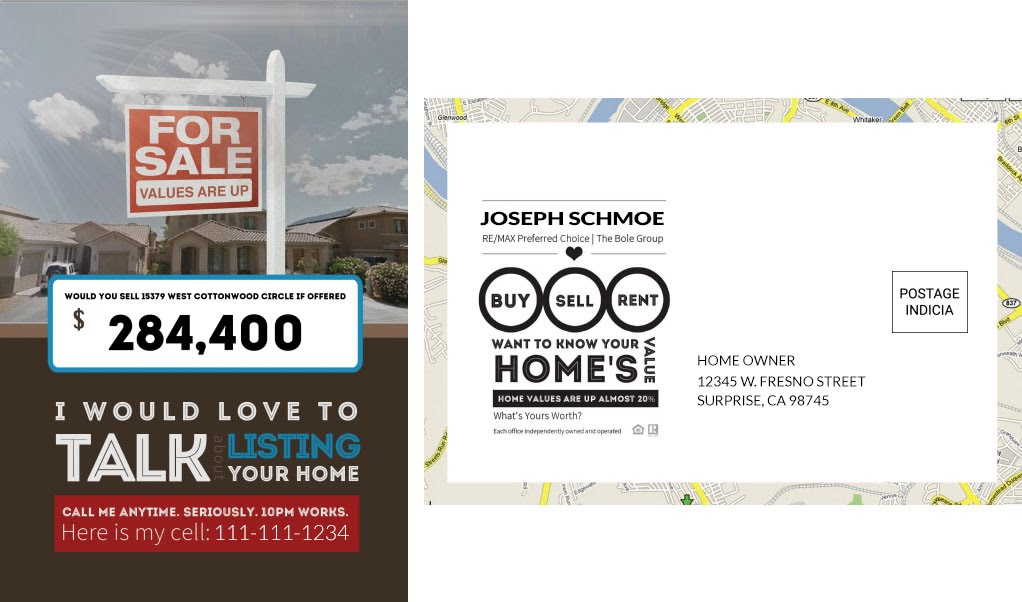
The postcard doesn't just contain a random image of a home in the seller's zip code; it contains a Google Street View of the seller's house with its estimated sales price. It also conveniently includes an agent's contact information. This direct mail personalization lifted IRE's postcard response rates fivefold over industry standards. The back view of this postcard is a sample and does not reflect the recipient, nor the realtor's name.
Build customer loyalty with automated thank-you letters
Thank-you letters keep customers coming back — and spending more. When customers feel connected to brands, more than half of consumers (57%) will increase their spending with that brand, and 76% will choose them over a competitor.
A direct mail automation platform handles personalized thank-you note templates and address verification, so you don't waste your marketing spend.
The Travis Manion Foundation, a national veterans service organization, used Lob's Address Verification API to ensure personalized thank-you letters to donors arrived without incident. Better yet, our integration with Travis Manion's CRM meant that welcome letters could go out the day a new customer placed an order.
Travis Manion not only improved the customer experience with this automated personalized mail—but they also reduced their costs by 50%.
Personalize and track your campaigns with QR codes
Now that nearly everyone has a smartphone, QR codes let you personalize direct mail and track every scan. Place a code on your mailer that leads each recipient to content curated just for them. For example, you can create different codes for "Mike" and "Mary" that send each to their own landing pages with personalized greetings, products, and/or offers.
And for marketers, every scan is a trackable data point that ties a physical mailpiece to a digital action.
Cruise operator Carnival segmented their loyal customers and used direct mail QR codes to offer them a $200 credit.
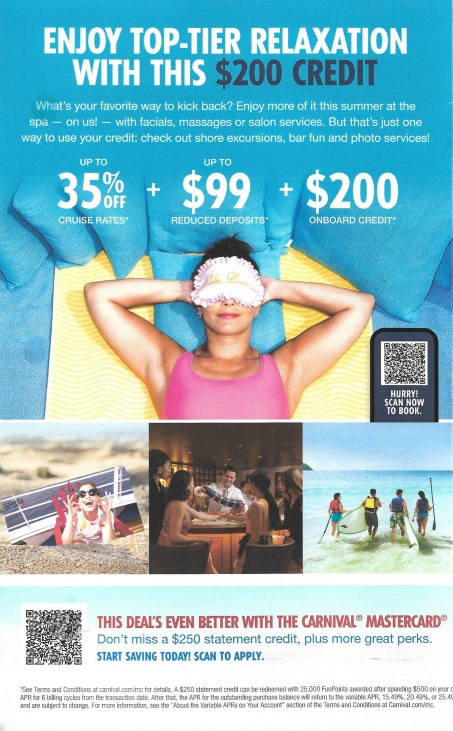
The QR code also made it possible for Carnival to track the ROI of this particular direct mail campaign. The company can track scans and bookings from the QR code's unique URL to measure campaign ROI.
Use referral codes to acquire new customers
Up to 40% of leads come from word-of-mouth marketing. Give customers a clear path to refer friends with personalized mailers. Put a unique referral ID for the recipient on your direct mailpiece, so you can easily see if a customer sends someone your way and reward them. You might also add their name to the mailer to personalize it even more.
Texas-based Reliant uses direct mail to encourage customers to share a personalized referral code with friends. If the friend signs up, both the new and referring customers get statement credits.
Physical mail sticks around — a referral postcard sits on a counter, gets pinned to a board, or gets handed directly to a friend — creating a social, word-of-mouth dynamic that's harder to replicate with a forwarded email.
Like QR codes, referral IDs can help you track the success of your campaign and open up additional direct mail marketing possibilities. Similar to Travis Manion, what if each referral ID redemption triggered a personalized thank-you letter from Reliant to the referring customer?
Personalize multiple mailer elements at once
You don't have to pick just one personalization tactic — you can combine multiple elements in a single mailer.
Direct mail platforms pull behavioral data from your CRM or e-commerce system — purchase history, product preferences, location, loyalty status — and populate each mailer automatically.
When resale fashion site thredUP approached us about using direct mail to encourage repeat purchases, it wasn't enough to personalize a single element of a postcard. They wanted to personalize multiple elements and had enough customer data to do it.
Lob's direct mail platform connected directly to thredUP's e-commerce software, so the brand could populate product suggestions, images, and discount expiration dates into mailers.
The result? thredUP saw a 15% increase in repeat purchases after implementing our automated direct mail solution.
Build personalized direct mail into your marketing strategy
The real challenge is personalizing direct mail without drowning in manual work.
Lob's direct mail automation platform automates data merges, design variations, and print handoffs. Our API pulls customer data directly from your CRM or e-commerce platform and populates your mailers — images, text, QR codes, promo codes, all of it.
Frequently asked questions
FAQs

Q: What is personalized direct mail?
Personalized direct mail uses recipient data — purchase history, location, account details — to customize each piece so it feels made for that one person.
A McKinsey study found that businesses excelling at personalization generate 40% more revenue than those that don't.
Q: What formats can you use for personalized direct mail?
Personalized postcards are the most common format — fast to produce, no envelope to open, and easy to customize with images, QR codes, or promo codes. Letters work well when you need more space or a more formal tone, like a thank-you note or a policy renewal. Self-mailers fold flat and keep costs lower for mid-length messages.
A win-back offer usually fits a postcard. A new donor welcome probably needs a letter. Where teams go wrong is defaulting to one format for everything — and then wondering why response rates vary so much across campaigns.
Q: How much does personalized direct mail cost?
A standard postcard typically runs between $0.50 and $1.50 per piece, including printing and postage — cost varies by format, volume, and how many elements you're personalizing. Letters or more complex formats can run higher. Per-piece costs drop as volume increases.
The hidden cost most teams underestimate is production time — manually managing data merges, design variations, and print handoffs adds up fast. With Lob, your CRM data populates directly into each piece, so you're not paying a team to babysit a spreadsheet every time a campaign goes out.
Answered by:

Sam Melero