Email marketing taught us a lot — segmentation, personalization, testing, iterating fast. But here's what most marketers miss: those same principles apply directly to your direct mail campaigns. And when you combine them, the results get even stronger. Direct mail paired with digital channels can lift response rates 2–3x compared to digital alone.
Direct mail creates something email can't — an emotional, physical connection. It generates excitement, anticipation, and trust. It also delivers strong ROI—response rates average 4–5% for house lists, compared to under 1% for email.
Here are 4 lessons you can borrow from email marketing to drive better results with your direct mail.
1. Personalization pays
Personalization was honed in email marketing from the days of inserting {first_name} in the subject line. That baseline expectation has carried over to direct mail — but too many teams stop at the first name and call it done. The real opportunity is in using behavioral and transactional data to shape the entire mailpiece: prior purchases, abandoned cart items, product usage patterns, even location.
Ideas for personalizing your direct mail campaigns include:
- Customer-specific images based on browsing or purchase history
- A personalized map showing how to get to your closest physical location
- Personalized landing pages (PURLs) that continue the 1:1 experience online
Generic mail gets treated like generic mail. Personalization is what turns a mailpiece into something worth holding onto — and acting on.
2. Strong creative captures attention
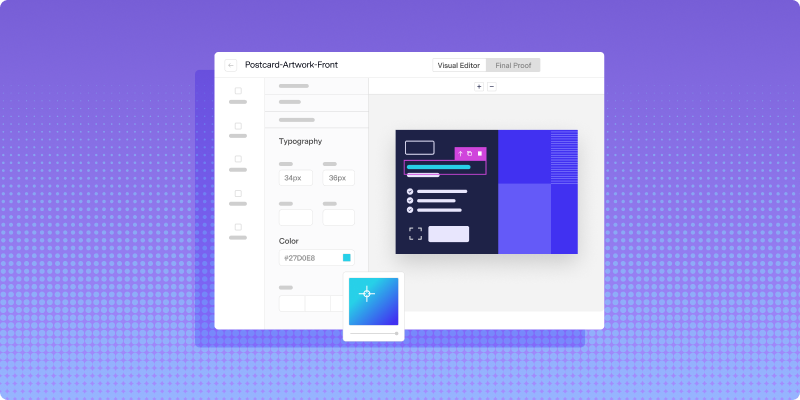
You don't need a designer to build effective direct mail anymore. Templates let you customize at the individual level without starting from scratch.
The same goes for automated direct mail—templates let you build a customized mailpiece in minutes, not hours.
Layout, colors, fonts, images, and white space all shape whether your mailpiece gets attention or gets tossed. Think layout, colors, font styles, images, and – yes – even how you use the white space. It all matters.
Stick to two or three fonts that match your brand and complement each other.
Choose colors that make sense for your audience — a healthcare facility using red, for example, risks signaling danger instead of care.
Use white space intentionally. Leaving room to breathe can be just as powerful as the images and text it surrounds.
Be creative, but be direct. A clear, well-designed mailpiece aligned to your audience will always outperform one that's cluttered with design elements competing for attention.
3. On-brand copy compels
On-brand copy helps customers understand what you're asking—and, more importantly, recognize who the mail is from immediately. Some of the most important aspects of email marketing should be leveraged for your direct mail, such as:
- Keep it short. Get to the point of your mailpiece fast. This ensures the recipient can clearly and quickly scan and understand what you're offering.
- Stay on-brand, every time. Your direct mail should feel like it came from the same company as your emails, your website, and your social posts. When the tone or look shifts between channels, recipients notice — even if they can't articulate why. Brand consistency in your copy reinforces trust and makes you instantly recognizable.
- Speak directly to the recipient. You're not speaking to an audience of millions at once – your messaging should read as though it was personally written just for its recipient. Convey your excitement, find common ground, and get them excited, too. This happens when copy is clear, relevant to the recipient, and offers something they didn't already know.
4. Enticing CTAs get action
Email marketing nails the CTA. A bold button, a clear action, and the deal closes in seconds. Direct mail doesn't have that clickable shortcut — so your CTA has to work harder. It comes down to three things: copy, placement, and the value behind the ask.
The best lessons for enticing CTAs you can learn from email marketing and apply to your direct mail campaigns are:
Be specific.
That's it – tell the recipient exactly what you want them to do.
Offer value.
Click Here works for email, but above the link, there's always some reason given why the recipient should take such action. In direct mail, your CTA cannot be generic. Think of ways you can best answer the question burning in your recipient's mind: Why should I?
Capitalize on FOMO.
Everyone experiences the Fear of Missing Out. Use it. Highlighting limited inventory, expiring offers, or exclusive access creates urgency and gives recipients a reason to act now instead of setting your mailpiece aside — where it may never get picked up again.
Use QR codes and personalized URLs.
CTAs like Call Us Today or Visit our website still work — but they're not your only options anymore. Email marketers have long relied on trackable links to measure engagement. QR codes and PURLs bring that same tracking capability to print, so you can see exactly how recipients respond:
- QR codes. Ask customers to scan the QR code with their device. This can be used for exclusive access to savings, personalized quotes, or other information.
- Personalized URLs. Also known as PURLs, a personalized URL or landing page is the latest way brands are personalizing the customer experience. Adding Visit [yourcompany].com/[recipient name] to your direct mail gives you a trackable response metric and a more personalized experience.
Make it simple.
All of the above should have moved your customer to the obvious next step—but is it obvious? Your CTA should be separate from the rest of the copy and simple enough that it's not difficult for your recipient to understand the ask and know the next step.
Frequently asked questions
FAQs

Is direct mail marketing still effective?
Yes — and the crowded inbox is part of why. Physical mail doesn't compete with hundreds of daily emails. Direct mail response rates average around 4–5% for house lists, compared to under 1% for email. The gap widens when you add personalization. What makes it work today isn't the format—it's combining behavioral data, well-segmented lists, and creative that speaks directly to the recipient. Done right, it outperforms most digital channels on response rate and cost per acquisition.
How much does direct mail marketing cost?
It depends on format, volume, and postage class. USPS Marketing Mail postage typically starts around $0.20–$0.25 per piece. Once you add printing and design, most campaigns land between $0.50 and $3.00+ per piece — postcards on the lower end, oversized formats on the higher end. Larger volumes bring the per-piece cost down. If you're running automated direct mail through a platform like Lob, you can cut production overhead—templates handle the design work, so you're not starting from scratch every campaign.
Is direct mail marketing legal?
Yes. Direct mail is legal in the US and doesn't require recipient opt-in the way email does under CAN-SPAM. USPS sets the rules on what can be mailed, how it must be addressed, and what postage class applies. You do need to follow postal regulations — accurate addressing, proper postage, no prohibited items. If you're sourcing mailing lists from a third party, check that the data was collected in compliance with applicable privacy laws, particularly if you're targeting residents in states with stricter data regulations.
Answered by:

Sam Melero