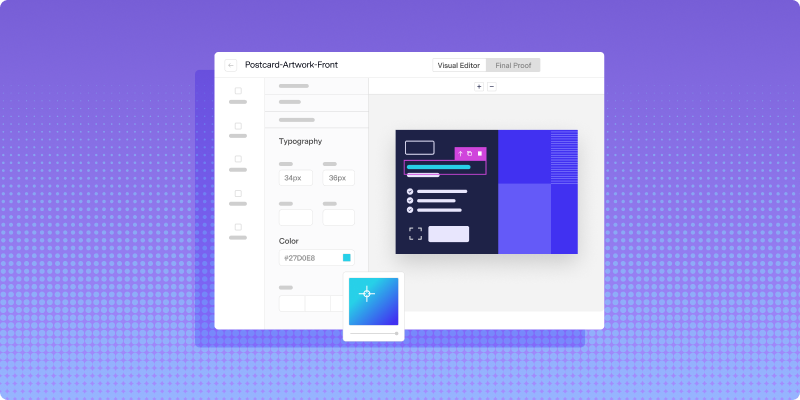
Before a direct mail campaign goes to print, there's one step that separates teams that catch problems early from teams that discover them after thousands of pieces have already shipped. That step is the mail proof.
What a mail proof is
A mail proof is a pre-production review of your mail piece before it goes to press. It shows exactly how the finished piece will look, including layout, typography, images, colors, personalization fields, and any variable content.
Depending on the format and production method, a proof can be digital or physical. A digital proof is a high-resolution file that replicates the printed piece on screen. A physical proof, sometimes called a hard proof or press proof, is an actual printed sample produced before the full run begins.
What a proof confirms
A proof catches errors that are easy to miss in a design file but obvious once printed. Common issues include:
- Text that gets cut off at fold lines or bleeds
- Colors that shift between screen and print
- Personalization fields that populate incorrectly or render as raw code
- Images that look sharp on screen but print at low resolution.
- Spacing and alignment that looks right digitally but breaks in the printed format.
For campaigns using variable data, proofing is especially important. Reviewing a sample of several variable records confirms that personalization renders correctly across different data combinations.
Who should review it?
A proof benefits from more than one set of eyes. The person who designed the piece knows what it's supposed to look like. Someone who didn't build it will catch things the designer has stopped seeing. For campaigns with compliance requirements, a legal or compliance reviewer should sign off before anything goes to press.
For high-stakes or high-volume campaigns, building a formal approval step with a seed list into your production timeline prevents last-minute scrambles and protects against errors that would be expensive to fix.
Physical vs. digital proofs
Digital proofs work well for most campaigns and fit naturally into fast-moving production timelines. Physical proofs take more time but give you the most accurate representation of how the finished piece will look and feel, including paper stock, color accuracy, and fold behavior.
For campaigns where the physical quality of the piece matters to the brand, or where color accuracy is critical, a physical proof is worth the extra time.
The cost of skipping it
A proof takes time. But skipping it could cost you. Reprinting a campaign after catching an error post-production is expensive. Mailing a campaign with an error in it is worse – whether that error is a wrong offer, a broken personalization field, or a compliance issue in regulated copy.
The proof is the last point in the production process where catching a problem is still cheap. After press, the options narrow considerably.
FAQs

Answered by:

Sam Melero