
State of Direct Mail
Business
Insights 2026
Letter from the CEO
Direct mail continues to be one of marketing’s most trusted and highest-performing channels. But the difference between good and great now comes down to operations – how efficiently teams produce, deliver, and measure every send.
Nearly 90% of marketing and operations leaders say logistics (printing, shipping, and delivery) remains a blind spot, often leading to surprise costs or missed timelines. The challenge isn’t USPS itself – it’s that many teams lack clear internal ownership of logistics, making it harder to stay ahead of pricing and service changes that directly affect planning and performance.
At Lob, we’ve seen how connecting data and logistics can turn direct mail into a measurable, efficient growth engine. When marketers have visibility into production and delivery, they move faster, reduce costs, and plan with confidence.
This year’s State of Direct Mail Business Insights explores the state of direct mail logistics, including where the bottlenecks are, and how high-ROI teams are streamlining creation, production, and delivery for better results.
Ryan Ferrier,
CEO, Lob
Study methodology
Lob, in partnership with Kelsey White Research Consulting, surveyed 250 senior marketing and operations leaders in North America who oversee direct mail programs. Respondents represented companies sending 1M+ mail annually across industries including financial services, healthcare, insurance, retail, and automotive.
Key findings
Direct mail is earning a bigger slice.
Companies now dedicate 25% of marketing budgets to direct mail, and 9 in 10 increased investment this year.

Broken logistics are breaking budgets.
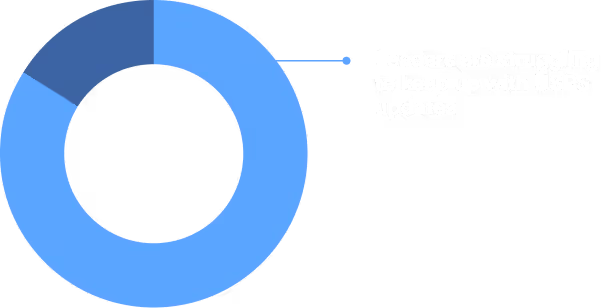
87% of leaders say printing, shipping, and delivery are major blind spots – creating surprise costs for 82% of teams.
USPS changes keep teams reactive.
84% percent of leaders struggle to track updates, and 51% say shifting rates and models have disrupted planning.
Clear ownership drives efficiency.
Teams without defined logistics owners are more likely to face delays, rising costs, and planning disruptions.
High-ROI teams use AI with intent.
While nearly everyone automates, top performers apply AI where it matters most, with personalization, attribution, and delivery accuracy.
Relevance drives strong personalization.
96% percent of leaders say personalization lifts results, but the strongest campaigns use behavior, preferences, and milestones to deliver perfectly timed mail.
Logistics
Logistics are a major operational blind
spot – and that creates surprise costs
Eighty-seven percent of leaders say logistics are a blind spot, and it’s costing them. From printing and
production to shipping and delivery, small breakdowns in the process can lead to big surprises. In fact,
82% have faced unexpected costs or missed delivery windows because of gaps in ownership and
oversight.
Only 39% have full, real-time visibility into delivery status, leaving most teams to work with delayed or
incomplete updates. As creative and targeting become more sophisticated, the production engine behind
them hasn’t kept up, making it harder to manage timing, control spend, and plan campaigns with
confidence.
82%
have faced unexpected costs or missed
delivery windows because of gaps in
ownership and oversight.
87%
of marketers say logistics are a blind spot.
Which of the following best describes the level of visibility your organization
has into the delivery status of direct mail campaigns?
Visibility drives results
Companies that report high ROI from DM campaigns are more
likely to have complete visibility into logistics than those with
lower ROI.
What sets leaders apart? We looked at high-ROI teams to understand what they’re
doing differently – and what other marketers can learn from their approach.
What are the top 3 challenges that you encounter with print vendors in your
direct mail campaigns?
USPS CHANGES
Lack of clear ownership makes USPS
changes harder to manage
Eighty-four percent of leaders say they struggle to track USPS changes or anticipate what’s coming next.
Many also report unclear ownership of logistics internally, with no one assigned to monitor upcoming
shifts.
The result: real operational strain. More than half of business leaders say USPS changes have significantly
disrupted their planning. Operations teams feel it most – 64% report major impacts, compared with 48%
of marketing roles – showing just how closely these changes tie to production and scale.
How much do USPS changes (such as pricing adjustments or service
updates) affect your ability to plan or forecast future direct mail campaigns?
High-ROI teams stay prepared.
Only 24% of top leaders say they struggle to follow USPS
changes, compared to 50% of lower-ROI teams.
What sets leaders apart? We looked at high-ROI teams to understand what they’re
doing differently – and what other marketers can learn from their approach.
Direct mail usage & performance
90% of leaders increased their allocation to
direct mail this year
Direct mail continues to command a healthy share of marketing budgets. On average, companies
dedicate 25% of their total spend to the channel, and 9 in 10 leaders increased that allocation since last
year. That steady investment reflects how direct mail has evolved, from a legacy tactic to a measurable,
data-driven part of modern marketing.
How has your company’s 2026 allocation of marketing budget to direct mail
changed compared to 2025?
Bigger budgets pay off.
High-ROI teams connect the dots. They're more than 3x as likely
to integrate analytics (54% vs 17%) and third-party data
(54% vs. 20%) for a fuller view of performance.
What sets leaders apart? We looked at high-ROI teams to understand what they’re
doing differently – and what other marketers can learn from their approach.
Approximately what percentage of your company’s 2026 marketing budget
is allocated to direct mail?
Direct mail usage & performance
Direct mail is a full-funnel channel
Direct mail continues to deliver across every stage of the lifecycle. Marketers rate it as very effective for
retention and customer acquisition. Even for harder-to-reach dormant or churned customers, leaders say
direct mail shows strong performance.
How effective is direct mail in meeting the following campaign goals?
Direct mail usage & performance
Direct mail format isn’t just design – it’s
strategy
Letters in an envelope remain the most widely used format, but catalogs and sealed snap-packs are
quickly gaining traction. Each format serves a distinct purpose and choosing the right one has become a
measurable performance driver.
Which of the following formats of direct mail are you most likely to use?
Fix the logistics issues slowing teams down
Learn how to evaluate your print provider on routing, redundancy, USPS entry,
automation, and tracking to improve speed and in-home predictability.

Direct mail Challenges
The hardest part of scaling mail is
execution
As direct mail grows more data-driven, the executional side is becoming more complex. The top concerns
leaders share for 2026 include developing advanced personalization strategies, integrating direct mail
into broader tech stacks, and better controlling campaign delivery times. Many also point to the difficulty
of juggling multiple vendors and navigating USPS pricing. The message is clear: success in 2026 will
depend less on creativity and more on coordination across data, technology, and delivery.
What do you anticipate will be your top 3 biggest challenges to using direct
mail in 2026?
Operational mail & compliance
Operations leaders feel the
strain of scale
As direct mail programs expand, operations teams feel the pressure of higher volumes. Their biggest
challenges aren’t creative – they’re logistical: maintaining quality control, balancing production capacity,
and keeping delivery schedules on track.
Compliance continues to be an area of concern in this year’s report. 86% of operations leaders cite timely
delivery as a top compliance challenge, and three-quarters say protecting sensitive data is a close
second.
When it comes to managing high-volume direct mail campaigns, what are
your biggest challenges?
What are the top 3 concerns you have when it comes to compliance in direct
mail execution?
AI & automation
Everyone’s using AI. High-ROI teams
use it differently
Ninety-nine percent of leaders use AI or automation in their programs, but high-ROI teams stand out in
how they use it, embedding AI where it drives real impact. They apply it to personalize messaging, refine
attribution models, and integrate behavioral data. These teams also use AI to guide creative decisions,
optimize send timing, and improve delivery accuracy.
How is your company using AI and/or automation in direct mail campaigns?
Compared to a year ago, which best describes how your company is using AI
and/or automation differently in direct mail campaigns?
Personalization
Personalization works best when data
does the heavy lifting
Nearly every marketer now agrees that personalization boosts response rates, up sharply from 84% last
year. But personalization has evolved. It’s no longer about adding a name to a mailer, it’s about connecting
data across channels to create messages that resonate.
Predictive models are driving that shift. These tools analyze customer data to decide who to target, when
to send, and how often. Eighty-four percent of companies now use predictive models, and 93% say they
lift conversions.
Which of the following data attributes used to personalize your direct mail
campaigns have been impactful in driving response?
Which do you feel is more effective in moving a customer to engage and
convert with direct mail?
Integrations
When mail talks to your stack, performance
follows
94% of leaders say direct mail delivers stronger results when integrated with other channels. The most
common integrations are with CRMs, marketing automation, and CDP platforms. Easy-to-integrate APIs
are also seen as critical to operational success – 96% of leaders agree they make a major difference in
how efficiently mail campaigns run.
Which of the following data tools or platforms does your company currently
integrate with direct mail campaigns?
Bigger budgets pay off.
High-ROI teams connect the dots. They’re more than 3x as likely
to integrate analytics (54% vs. 17%) and third-party data
(54% vs. 20%) for a fuller view of performance.
What sets leaders apart? We looked at high-ROI teams to understand what they’re
doing differently – and what other marketers can learn from their approach.
Measurement
Multiple signals give a clearer picture
of performance
Marketers are expanding how they measure direct mail. By tracking a wider mix of response signals, like
PURLs, QR codes, and promo codes, they can see what’s working from multiple angles. This diversity
matters: when one data point (like web visits) is noisy, others still tell the story. But there’s room to grow –
only 22% track QR codes and 31% capture in-store redemptions, leaving untapped opportunities for
better visibility.
Which of the following methods does your company use to measure
response from your direct mail campaigns?
Conclusion
Smarter logistics, stronger mail:
Four moves to make now
Direct mail’s strength is clear, but this year’s findings show operational precision will drive
higher ROI in the future. Here are a few steps to put these insights into practice:
- Build logistics intelligence. From print quality to delivery timing, greater
visibility across logistics reduces surprises, controls costs, and turns mail
execution into a competitive advantage. - Stay ahead of USPS changes. Assign clear ownership for monitoring pricing
and service updates so teams can adapt faster and plan confidently. - Connect data and delivery. Link direct mail with CRM, CDP, and automation
tools to trigger timely, personalized mail tied to customer behavior. - Broaden your measurement mix. Track multiple response signals—QR scans,
PURLs, redemptions, and digital engagement—to get a more accurate view of
what’s driving performance.
Survey Methodology
About the respondents
Seniority
Department
Firm Size
2026 Marketing Budget Allocation to Direct Mail
Annual Direct Mail Volume
Industry
Mail that's high volume and high quality? Absolutely.


