
Agencies need more from a direct mail platform than printing and postage. The platform must accommodate different clients, technical requirements, brand standards, campaign types, and reporting expectations without forcing the agency to rebuild its process for every account.
Lob gives agencies several ways to create, automate, and measure direct mail from one platform. Agencies can start with dashboard-based campaigns, connect client systems through integrations, build custom workflows with APIs, or offer direct mail under their own brand.
What makes a direct mail platform easy for agencies to use?
An agency-friendly platform should be easy to introduce across accounts without requiring every client to use the same tools or implementation.
That means an agency should be able to:
- Launch campaigns without extensive development
- Support custom integrations when clients need them
- Keep client campaigns and data organized
- Personalize mail using existing customer information
- Provide clients with clear production and delivery reporting
- Maintain consistent quality across campaigns
- Support additional security requirements for regulated clients
- Present direct mail as part of the agency’s own service offering
Lob combines these capabilities through its campaign tools, APIs, integrations, Print Delivery Network, and agency-focused platform.
How an agency platform simplifies direct mail
Traditional direct mail frequently requires agencies to coordinate several separate steps. Recipient lists are exported, creative files are transferred to a printer, proofs move through email, and reporting arrives after the campaign has already ended.
An automated platform connects these activities in one workflow. Agencies can use templates, client data, integrations, and campaign rules to initiate mail without coordinating every production step manually.
This approach gives agencies:
- One system for campaign creation and production
- Automated data transfers instead of repeated list uploads
- Template-based personalization
- Mailpiece-level production and USPS tracking events
- Campaign information that can connect to client reporting systems
Once an agency establishes a campaign framework, it can adapt the audience, creative, offer, and timing for each client. Direct mail becomes an ongoing service instead of a separate production project every time.
Offer direct mail under your agency’s brand
Agencies generally want to own the client experience. Sending clients to an unfamiliar print vendor can make direct mail feel disconnected from the rest of the agency’s work.
Lob supports white-label direct mail, allowing agencies to provide a branded experience while Lob manages production, routing, and tracking in the background.
This model gives the agency control over:
- How the service is positioned
- Which campaign options are offered
- How creative is reviewed
- How results are presented
- How direct mail fits into the broader client strategy
Clients continue working with the agency they know, while the agency avoids building its own print and fulfillment infrastructure.
Choose the right setup for each client
One client may want a simple quarterly postcard campaign. Another may need personalized mail triggered from a CRM or custom application. Requiring both clients to follow the same implementation would create unnecessary friction.
Lob supports several ways to work.
Launch campaigns from the dashboard
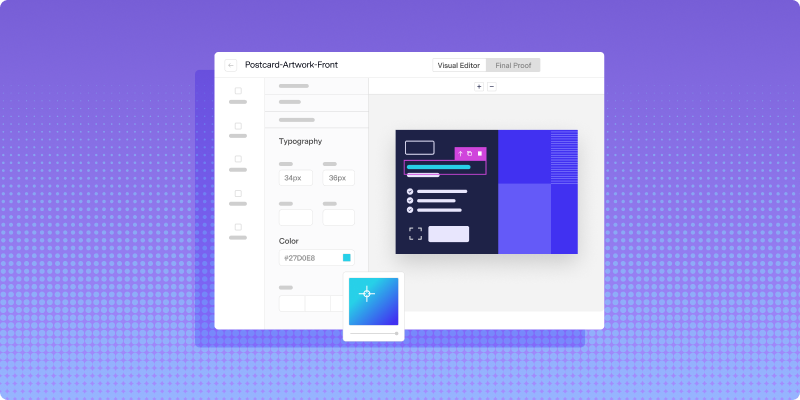
Campaign teams can build and manage direct mail through Lob’s visual tools. This is useful for scheduled, audience-based campaigns that do not require a custom technical implementation.
An agency can prepare the audience, select the creative, review the campaign, and initiate the send without assigning engineering resources to every account.
Connect supported platforms without custom development
Lob offers no-code integrations for supported CRM and marketing systems. These connections allow agencies to create automated campaigns based on changes or events in client data.
For example, a campaign could send mail when:
- A lead reaches a specific CRM stage
- A customer completes a purchase
- A subscription approaches renewal
- A previously active customer becomes unresponsive
- A recipient qualifies for a particular offer
The client’s existing system remains the source of the trigger, while Lob handles the mail workflow.
Build custom experiences with APIs
Clients with custom applications or more advanced requirements can use Lob’s APIs and integrations.
API access gives technical teams more control over when mail is created, what data it contains, and how events flow back into other systems. Agencies can use this option for custom client portals, proprietary campaign tools, or direct mail services built into an existing product.
The agency does not have to choose between ease of use and technical flexibility. It can select the implementation that fits each account.
Onboard new clients without starting over
Adding a client should not require the agency to learn a completely different production system.
With Lob, agencies can reuse campaign foundations while changing the details that make each program distinct:
- Brand assets and templates
- Recipient data
- Personalization fields
- Approval requirements
- Campaign triggers
- Mail formats
- Reporting preferences
A retail client might use postcards for abandoned-cart campaigns, while an insurance client sends personalized renewal letters. The programs serve different purposes, but the agency can manage both through the same underlying platform.
This makes it easier to move from client approval to campaign execution without forcing every client into an identical program.
Keep client programs organized
Multi-client work becomes risky when creative files, audience lists, and campaign reports live in shared folders without clear ownership.
An agency platform should make it easy to identify which resources belong to which client and control who can access them. Lob supports multi-account agency workflows so teams can organize campaign activity while maintaining appropriate separation between client programs.
Before onboarding a client, the agency should define:
- Who can create or edit campaigns
- Who approves creative and recipient data
- Which client stakeholders need reporting access
- Where campaign and delivery data will be stored
- How long sensitive data should be retained
- Which events should be sent back to client systems
These decisions make the client experience easier and reduce the chance of data or creative being used in the wrong campaign.
Give clients useful delivery visibility
Clients often ask whether their mail has gone out, where it is in the process, and when follow-up outreach should begin.
Lob surfaces production and USPS tracking events at the mailpiece level. Agencies can use these events to monitor campaign progress, identify exceptions, and coordinate other channels.
For example, an agency might schedule an email after the expected in-home window or notify a sales team when a high-value account’s mailpiece reaches a late delivery stage.
Tracking events provide mailstream visibility. They do not prove that a particular person received, opened, or read the mail. Agencies should explain that distinction when presenting campaign reports.
Report on delivery, response, and conversion separately
Client reporting becomes clearer when it separates three different types of information:
- Delivery: What happened to the mailpiece in production and the postal network?
- Response: Did the recipient scan a QR code, visit a personalized URL, call a dedicated number, or redeem an offer?
- Conversion: Did the recipient complete the business action the campaign was intended to influence?
Lob can surface campaign and delivery data, while QR codes, personalized URLs, offer codes, CRM activity, and matchback analysis can help connect mail to downstream behavior.
Agencies can use these signals to build more useful reports without claiming that a delivery event caused a conversion. Lob’s guidance on getting better direct mail reporting provides a framework for connecting these stages.
Maintain quality across different client brands
An agency’s reputation is attached to every piece it sends. Colors, image quality, paper, trim, and placement must remain consistent with the approved design.
Lob coordinates production through its nationwide Print Delivery Network rather than requiring agencies to select facilities for each campaign. Shared standards and quality controls help maintain consistent print output across locations.
This is especially important for agencies managing several brands with different creative requirements. The agency can focus on whether the design meets the client’s standards instead of managing quality processes separately with regional printers.
Support regulated client requirements
Healthcare, insurance, and financial-services clients may require additional reviews before approving a direct mail platform.
Lob protects customer data with encryption in transit and at rest, account controls, audit and API request logs, and data-retention practices. Lob also completes annual SOC 2 Type 2 audits and supports HIPAA-aligned workflows, including Business Associate Agreements for eligible customers.
These controls can make vendor review easier, but they do not automatically make every campaign compliant. The agency and client must still determine which rules apply to the content, format, audience, and mailing process.
Lob’s security and compliance documentation can help agencies answer client questions during that review.
How to evaluate Lob for your agency
Before selecting a direct mail platform, consider how it will affect both your team and your clients.
Ask:
- Can nontechnical team members launch campaigns?
- Are APIs available for clients with custom requirements?
- Can we connect campaigns to the systems our clients already use?
- Can we offer the service under our own brand?
- Can we organize different client programs appropriately?
- Can we personalize individual mailpieces using client data?
- What production and quality controls are documented?
- What mailstream information can we share with clients?
- Can campaign events feed existing reporting systems?
- What security documentation is available for client reviews?
The easiest platform is not simply the one with the fewest features. It is the one that gives the agency a straightforward starting point without limiting what it can build later.
Add direct mail to your agency with Lob
Lob allows agencies to launch simple campaigns, create automated customer journeys, or build customized direct mail services from the same platform.
Your agency stays responsible for the strategy and client experience. Lob supports the campaign infrastructure, production network, postal routing, and mailstream visibility needed to execute that strategy.
Book a demo to explore the right setup for your agency.
Frequently asked questions about scaling direct mail with Lob
FAQs

Can agencies offer Lob under their own brand?
Yes. Lob supports white-label implementations that allow agencies to provide a branded experience while Lob manages production, routing, and tracking.
Does an agency need developers to start using Lob?
Not necessarily. Agencies can create campaigns through the Lob dashboard and use supported no-code integrations. APIs are available when a client needs a custom workflow or deeper connection to its existing systems.
Can different clients use different Lob implementations?
Yes. One client could use dashboard-based campaigns while another uses a CRM integration or custom API workflow. Agencies can choose the setup that fits each client’s program.
Can agencies personalize mail for individual recipients?
Yes. Agencies can use client data to change text, images, offers, and other approved elements for individual recipients or audience segments.
Does Lob tracking prove that a recipient received the mail?
No. Tracking events provide visibility into production and USPS mail processing. They do not prove that a specific person personally received, opened, or read a mailpiece.
Can Lob support agencies with healthcare clients?
Lob supports HIPAA-aligned workflows and offers Business Associate Agreements for eligible customers. The agency and healthcare client should still review the campaign’s content, format, data, and applicable compliance requirements.
Answered by:

Sam Melero